Newborn Baby Care Tips Every First-Time Parent Should Know
Essential newborn baby care tips for first-time parents, from feeding and safe sleep to bathing, diaper changes, skin care and newborn comfort.
The Lumi9 Team12 min read
The first night you bring your newborn home can feel strangely quiet.The hospital bag is still half-unpacked. Someone has left a tiny pair of socks on the sofa. Your baby is finally asleep, and for the first time all day, nobody is telling you what to do next.So you stand there and look at this impossibly small person.Then the questions begin.“Did my baby drink enough?”“Is that breathing normal?”“Should I wake the baby for a feed?”“Is the diaper too tight?”“Why is the baby crying again?”“Am I doing any of this right?”No one hands a first-time mom confidence along with the birth certificate. Most moms build it slowly—one feed, one diaper change, one sleepless night and one tiny lesson at a time.These newborn baby care tips are not here to make motherhood feel like another test you must pass. They are here to help you understand the everyday basics: feeding, safe sleep, bathing, umbilical cord care, diaper changes, baby skin, soothing and the moments when you should call a doctor.Because your baby does not need a perfect mom.Your baby needs a cared-for, informed mom who keeps showing up—and you are already doing that.
1. Learn Your Baby Before You Try to Follow Every Rule
In the first few weeks, advice arrives from everywhere. Family members, friends, social media, parenting groups and well-meaning relatives may all tell you the “right” way to feed, burp, bathe, hold or settle your baby.Reliable guidance matters, but so does learning your own baby.Newborns communicate through small signals: turning toward the breast or bottle, opening the mouth, rooting, bringing hands toward the face, fussing, becoming quiet, stiffening, looking away or crying. Over time, you start recognising what different movements may mean.That recognition is not instant. It grows with repetition.Instead of expecting yourself to understand every cry on day one, think of the first weeks as getting to know a new person who does not yet speak your language.
2. Feeding: Watch the Baby, Not Only the Clock
Newborn feeding is one of the biggest sources of anxiety for first-time moms. WHO breastfeeding guidance recommends breastfeeding within the first hour after birth where possible, exclusive breastfeeding for the first six months, and feeding according to the baby's cues. If breastfeeding is painful, your baby is having difficulty latching, or you are worried about milk transfer, speak with your pediatrician, maternity team or a qualified lactation professional.
UNICEF notes that newborns commonly feed very frequently, often around every two to three hours, although individual patterns vary.If breastfeeding is painful, your baby is having difficulty latching, you are worried about milk transfer, or feeding is becoming overwhelming, ask for help from your pediatrician, maternity team or a qualified lactation professional. Feeding support is not a sign that you are failing. It is part of newborn care.
3. Safe Sleep Is One Area Where Clear Rules Matter
There are many areas of parenting where families can choose what works best. Safe infant sleep is different because the sleep environment affects safety. The American Academy of Pediatrics safe-sleep guidance recommends placing babies on their backs for every sleep on a firm, flat, non-inclined surface and keeping pillows, loose blankets, bumper pads and stuffed toys out of the baby's sleep space. A beautifully decorated cot may look comforting to an adult, but a simpler sleep space is safer for a newborn.
4. Your Newborn Does Not Need a Complicated Bath Routine
That first bath can make even a confident adult suddenly feel as if babies are made of glass. They are slippery, tiny and sometimes deeply unimpressed by the whole idea. NHS newborn bathing guidance explains that plain water is enough for very young newborn skin and recommends gentle washing and careful drying, especially between skin folds. Keep everything you need within reach before you begin, support your baby's head securely, and never leave a baby alone in or near water—even for a moment.
5. Umbilical Cord Care: Keep It Simple
The umbilical cord stump can look intimidating at first, but routine care is usually simple. NHS guidance for caring for a newborn supports keeping the area clean and dry and following the advice given by your maternity team or pediatrician. If the stump becomes dirty with urine or stool, clean gently with water and pat dry. Do not pull it off; let it separate naturally. Contact a healthcare professional if you notice spreading redness, pus, persistent bleeding, a bad smell, fever or if your baby seems unwell.
6. Diaper Changes Become One of Your Most Frequent Care Routines
A first-time mom may change more diapers in the first few weeks than she expected to change in a lifetime. At first, every change feels like a small operation. Soon, your hands remember the routine without your brain having to think about every step. NHS diaper-changing guidance recommends changing wet or soiled diapers promptly because newborn skin is delicate.
How to Put on a Newborn Diaper
- Wash your hands and prepare the fresh diaper before removing the used one.
- Lay your baby on a safe, flat changing surface and keep one hand close to the baby at all times.
- Clean the diaper area gently, wiping from front to back.
- Pat the skin dry rather than rubbing.
- Slide the clean diaper underneath the baby.
- Fasten it securely without making the waist or leg area excessively tight.
- For a baby whose umbilical stump is still present, follow the diaper design and your healthcare team's advice so the area is not unnecessarily rubbed or covered.
7. Choosing Newborn Baby Diapers: Comfort Is More Than Absorbency
The keyword newborn baby diapers may sound purely commercial, but the person searching it is often a mom asking a much more human question: “What will feel comfortable on my baby's skin?” When comparing diapers for a newborn baby, look beyond the pack design. A newborn diaper should suit the baby's current weight and body shape and support softness, moisture management and a secure fit. For a deeper look at airflow and diaper construction, read Lumi9's guide to what makes a baby diaper breathable.
What to Look for in Newborn Diapers
- Correct newborn diaper size and weight range
- Soft skin-contact surface
- Good moisture absorption
- Breathable outer construction
- Secure but gentle waist and leg fit
- Leakage barriers
- Easy changing design
- Clear product and material information
Where Lumi9 Fits into Newborn Comfort
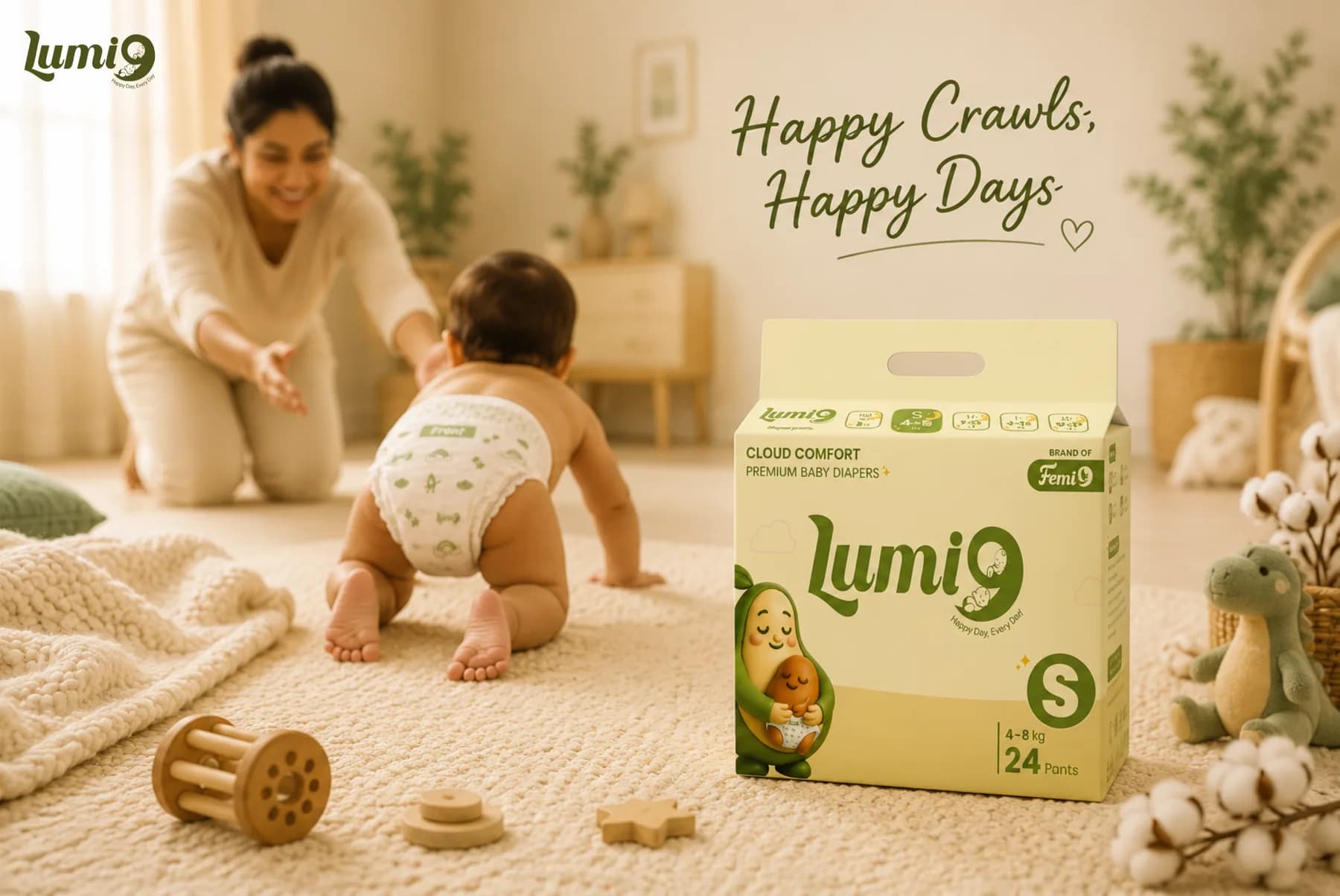
Lumi9 brings several comfort and moisture-management features together in one diaper system.Aloe Vera-Infused Top Sheet: designed to support skin smoothening and rash-free comfort for delicate baby skin.ADL (Acquisition Distribution Layer): helps distribute liquid more evenly across the absorbent area.Advanced SAP Core: designed to absorb and hold moisture.Breathable Backsheet: supports airflow through the outer layer.Wetness Lock Technology: helps manage absorbed moisture within the diaper structure.Double Leakage Barrier: supports side-leakage protection.Wetness Indicator: provides a visible cue that can help moms know when the diaper may need checking.These are separate functions working together. In particular, the Aloe Vera-infused top sheet and the ADL should not be described as the same feature: Aloe Vera supports skin smoothening and rash-free comfort, while ADL supports liquid distribution.
8. Diaper Rash Prevention Starts With the Routine, Not One Product Claim
Newborn skin is delicate, and redness in the diaper area is common. It can be related to prolonged wetness, stool contact, friction, skin sensitivity, fit and other causes.No diaper should be marketed as a guarantee against diaper rash.Practical newborn diaper-rash prevention includes checking the diaper frequently, changing wet or soiled diapers promptly, cleaning gently, drying the skin carefully, using the correct diaper size and allowing some diaper-free time when practical.If a rash becomes severe, spreads, blisters, does not improve, or your baby appears unwell, seek medical advice.
9. Crying Is Communication, Not a Scorecard for Your Motherhood
There will be evenings when your baby is fed, changed, warm, held and still crying.Those moments can feel personal.They are not.Newborns cry for many reasons: hunger, tiredness, discomfort, overstimulation, the need for closeness, temperature changes or simply because crying is one of the few communication tools they have.Check the basics. Hold your baby. Reduce stimulation. Try gentle movement or skin-to-skin contact if appropriate.And if the crying feels unusual, is accompanied by illness symptoms, or your instincts tell you something is wrong, contact your pediatrician.You do not earn motherhood points by handling every difficult moment alone.
10. Your Baby's Skin Needs Gentle Care, Not a Shelf Full of Products
Newborn skin is still adapting to life outside the womb. Dryness, peeling and small changes can occur, and not every change requires another product.Use simple, gentle care. Avoid heavily fragranced or unnecessary products on delicate newborn skin unless advised by a healthcare professional.When choosing clothing, wipes, cleansers or diapers, pay attention to how your own baby's skin responds rather than assuming the same routine works for every baby.
11. Learn the Signs That Need Medical Attention
A parenting blog cannot replace a pediatrician, especially during the newborn period.Seek urgent medical advice if your newborn has difficulty breathing, is unusually difficult to wake, is feeding poorly, has a concerning change in colour, has significantly fewer wet diapers than expected, has repeated vomiting, or simply seems seriously unwell.Fever in a very young baby also deserves prompt medical assessment. Follow the advice of your baby's pediatrician and local healthcare service.One of the most useful first-time-parent habits is learning this sentence:“I am worried about my baby and I would like someone to check.”You never need to apologise for saying it.
12. Take Care of the Mom Who Is Taking Care of the Baby
Newborn care advice often talks about the baby as if the mom has stopped being a person.You have not.You may be healing. You may be sore. You may be running on broken sleep. Feeding may not be going the way you imagined. Your emotions may change by the hour. You may love your baby deeply and still desperately miss ten uninterrupted minutes alone.Both things can be true.Accept help with food, laundry, errands and household work when you can. Rest in small pockets. Tell someone if you feel persistently low, overwhelmed, frightened, disconnected or unable to cope.A cared-for mom is part of newborn care too.
A Simple First-Time Mom Newborn Care Checklist
- Feed according to your baby's cues and healthcare guidance.
- Place your baby on the back for every sleep on a firm, flat sleep surface.
- Keep the sleep space free from pillows, loose blankets and soft toys.
- Change wet or soiled diapers promptly.
- Choose the correct newborn diaper size and check the waist and leg fit.
- Keep bathing and skincare gentle and simple.
- Keep the umbilical stump clean and dry.
- Watch your baby's feeding, wet diapers, alertness and overall behaviour.
- Keep pediatrician and emergency contact details easy to find.
- Ask for help before exhaustion becomes overwhelming.
Final Thoughts: You Are Learning Your Baby, and Your Baby Is Learning You
A few months from now, some of the things that frighten you today will become automatic.You will change a diaper in the dark.You will know the difference between the hungry cry and the tired cry.You will pack the diaper bag without a checklist.You will pick your baby up and somehow know that something feels different.But you do not need to be that version of yourself today.Today, it is enough to learn the next small thing.Feed the baby in front of you.Make sleep as safe as you can.Keep the skin clean and comfortable.Change the diaper.Ask the question.Call the doctor when you are worried.Rest when somebody gives you the chance.Motherhood is not built in one perfect day. It is built through thousands of ordinary moments in which you keep choosing care.And somewhere between those feeds, diaper changes, tiny yawns and 3 a.m. cuddles, confidence quietly starts finding you.
Discover Lumi9 Newborn Baby Diapers
Frequently asked questions
- What are the most important newborn baby care tips for first-time parents?
- Focus first on safe feeding, safe sleep, hygiene, regular diaper changes, gentle skin care, umbilical cord care and learning your baby's normal behaviour. You do not need to master everything immediately.
- What is the best diaper size for a newborn?
- Choose according to the manufacturer's weight range and your baby's actual fit. A good fit should sit securely around the waist and legs without excessive gaps or deep pressure marks.
- Are soft baby diapers for newborns important?
- Softness is an important comfort consideration because a diaper stays close to delicate newborn skin for long periods. Fit, absorbency, moisture management and regular changing are also important.
- Are breathable newborn diapers better?
- A breathable outer layer can support airflow and everyday comfort, but breathability is only one part of diaper design. Proper fit, absorbency and timely changes remain essential.
- How do I know whether my newborn is feeding enough?
- Feeding patterns, swallowing, alertness, weight gain and wet diapers are among the things healthcare professionals consider. If you are worried, speak with your pediatrician or lactation professional rather than relying only on online checklists.
Discover Lumi9 Baby Diapers
Looking for newborn baby diapers designed around softness, moisture management, breathable comfort and practical protection? Explore Lumi9 and choose the diaper size suited to your baby's early days.